Last week I received an email from my mother, who had yet to decide who she was voting for in tomorrow’s Canadian election.
“It saddens me that Mulcair paints evangelicals as un-Canadian” she wrote.
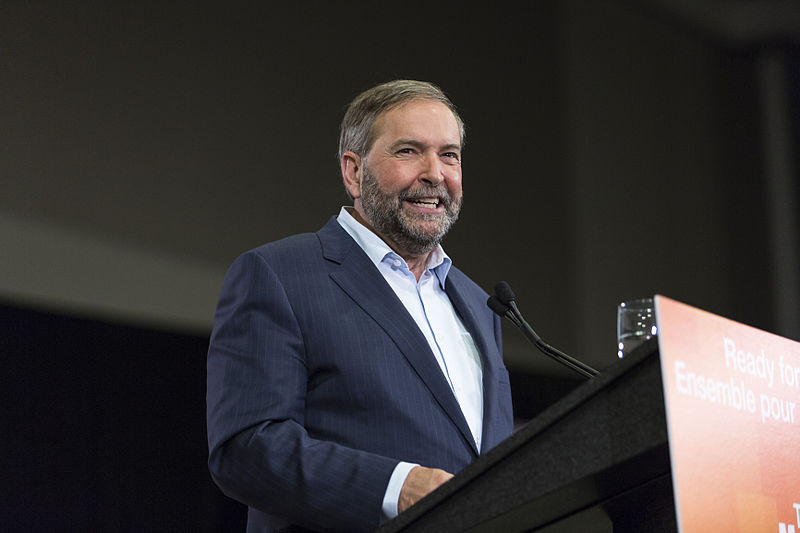
Thomas Mulcair is the leader of the centre-left New Democratic Party (NDP), which if you believe the polls, will finish in third place in tomorrow’s election, despite having been the front-runner early in the campaign.
I have been following the campaign closely, but had not heard anything about Mulcair calling evangelicals un-Canadian. So I turned to Google to find out more.
The Background
The claim that Mulcair called evangelicals un-Canadian actually dates back to February 2013. At that time, Crossroads Christian Communications, an evangelical organization, had been receiving $544,813 from the Canadian government for a water and sanitation project in Uganda. Crossroads came under fire for a list of ‘sexual sins’ on its website which included “pedophilia, homosexuality and lesbianism, sadism, masochism, transvestism, and bestiality.”
Critics were particularly concerned that the Government would fund a group holding these views working in Uganda, because the Ugandan government was in the process of introducing an anti-gay bill, and the death penalty was being put forward as a potential punishment. Crossroads argued that their position on homosexuality was grounded in Scripture, and said that their development work in Uganda did not include any evangelism and did not discriminate based on sexuality.
Misleading Headline
The top story when you Google ‘Mulcair and Evangelicals’ is from the Toronto Sun, with the headline ‘Evangelicals are un-Canadian: NDP leader Thomas Mulcair’.
This headline insinuates that Mulcair used the term ‘un-Canadian’ in reference to evangelicals, but if you read the story, there is no quote to back this up.
I tracked down the video of his remarks, which Mulcair made in the foyer of the House of Commons after the International Cooperation Minister Julian Fantino had defended the funding made to Crossroads. Here is the video, and below I have transcribed what Mulcair said:
It’s shocking to hear Minister Fantino defend the indefensible. Standing up today and defending a group that on its website is attacking something that’s recognized and protected by Canadian law. So it goes against Canadian values, it goes against Canadian law, and he can’t defend that. We don’t understand how the Conservatives, out of one side of their mouth correctly condemn Uganda’s laws on this issue, and then on the other hand subsidize a group in Uganda whose views are identical to the Ugandan government. So it is not a question of saying we shouldn’t subsidize groups who have a religious base. There are lots of groups that have a religious base over the years. But it’s interesting to watch with the Conservatives, groups like Kairos, like Development and Peace, that do have a lot of people with a religious background involved, and those are the values that motivate them, they’re getting cut, but at the same time these types of evangelical groups with vision that goes completely against not only Canadian values but Canadian law are getting Canadian taxpayers money.
There is a lot to unpack in this statement.
Mulcair never calls evangelicals un-Canadian. He does say that the vision of certain evangelical groups goes against Canadian values and law, but this is not as pejorative as calling them un-Canadian, and he also never address evangelicals as a whole. It is also significant that Mulcair says this is not a question of refusing to fund organizations that operate based on religious principles.
However, I do agree that Mulcair should be criticized for equating the views of Crossroads with those of the Ugandan government. It is one thing to think homosexuality is a sin, and quite another to believe it should be criminalized and severely punished.
But Wait. Did John Baird call evangelicals un-Canadian?
Mulcair was not the only prominent politician to comment on the Crossroads controversy. Speaking about the Crossroads website controversy in committee, Conservative Foreign Minister John Baird said (the video is also available here):
I think it’s really important that we put on record one thing. The suggestion that anyone politically, or at the public service level, at CIDA, or at DFAIT would share or endorse the kind of offensive and mean-spirited statements that appeared on a website…. I want to categorically, on behalf of the government, say that we completely reject those sentiments. If there’s any evidence that anyone receiving a grant from the Government of Canada is using that money to spread hateful, mean-spirited, or offensive practices, it will be put to an end immediately. Those are not the views of the government.
One of the most important responsibilities the Prime Minister has given Julian and me is to promote Canadian values. Canadian values are accepting; they’re tolerant; they welcome diversity. One of the great gifts that Canada has is to promote pluralism around the world. We respect religious freedom. At the same time, Canadian taxpayers’ dollars will not be used to spread hate or intolerance. That is completely unacceptable, would be un-Canadian, and would not back up the values that make this country great.
I personally find the language used by Baird to be just as forceful, if not more so, than the language used by Mulcair. I also find it ironic that it is Baird, and not Mulcair, who uses the term ‘un-Canadian.’
If evangelicals are upset with Mulcair’s comments, they should be equally upset with Baird, who characterized the views on Crossroads’ website as ‘offensive and mean-spirited.’ He also rejects the idea that anyone in the public service would hold these views, even though the view that homosexuality is a sin is widely held among evangelicals.
So why does Baird get a free pass for this, while Mulcair gets criticized? I think a major reason is the misleading headline that the Toronto Sun gave to the Mulcair story, which is cited in other stories and on social media as proof that Mulcair called evangelicals ‘un-Canadian.’
On the other hand, the Toronto Sun story about Baird’s comments was ‘Tories divided over funding humanitarian aid by evangelicals’. The article does provide a brief quote from Baird, but crucially leaves out the fact that he used the term ‘un-Canadian.’ The article also includes a quote from another Conservative MP expressing his disappointment that Mulcair called evangelicals ‘un-Canadian,’ which is quite ironic under the circumstances.
Now, I can hear you saying something about how this is no surprise, that the Toronto Sun is known for being ideologically conservative. I do think that this media angle is important. For example, a CBC story about Baird’s comments has the headline ‘John Baird slams anti-gay statements by CIDA-funded group.’ I think this headline is fair and could have equally been applied to the Mulcair story in the Toronto Sun. However, I think that this goes beyond media partisanship.
Canadian Values and the Perceived Persecution of Evangelicals
The reason that painting Mulcair as standing against evangelicals is so effective is because it fits into the evangelical narrative that their way of life is under threat because of political correctness. This is a large and complicated topic that I will have to save for another time, but suffice it to say that many evangelicals bemoan what they perceive as an increasingly anti-Christian society. Evangelicals will argue that in the age of political correctness, you can’t get away with criticizing any religion except Christianity.
Essentially, the argument goes, Mulcair could have never gotten away with saying the same thing about Muslims, but he can easily say it about evangelicals.
I have always been unconvinced by this line of argument. I think it is part of the evangelical persecution complex, and I think other groups in Canada have a much harder time than evangelicals. And now we have this election as a great example, where anti-Muslim sentiment masquerading as a desire to protect ‘Canadian values’ has been a major feature of the campaign.
Voting is Important. But it is only the Beginning.
Most evangelicals I know care deeply about both their local communities and about the world. Spending time with evangelicals can be exhilarating, because they believe that a better world is possible, and that it starts with following Jesus’ example of selflessness.
But spending time with evangelicals can also be frustrating, because they can spend a lot of time worried about the diminishing role of Christianity in culture, and they see enemies everywhere, even where they don’t exist.
As we go to the polls tomorrow, I hope that everyone, and especially evangelicals, remembers that creating a truly great society depends on much more than the government in power. So regardless of who we vote for, let’s agree to love our neighbour, care for the stranger, and give generously to the poor.
 Paul Anderson